
A specific change in head position may cause nystagmus that outlasts the head movement. Although the classic and commonest cause of this phenomenon is BPPV (benign paroxysmal positioning vertigo), there are also central causes of this phenomenon. This central positional nystagmus may be either paroxysmal or persistent; however, both forms commonly coexist.
Positional nystagmus may be caused by neurological diseases affecting the central vestibulocerebellar pathways, such as cerebellar degeneration, MS, posterior fossa neoplasms, Chiari malformation, and vestibular migraine1.
In contrast to BPPV, additional neurological or ocular motor symptoms or signs are typically present. Typical nystagmus of BPPV is most uncommon.
Features of central positional nystagmus include1,3:
- The nystagmus may have any trajectory, but pure downbeat and pure horizontal forms are far more common than upbeat, torsional, or mixed forms. Although all these features immediately imply a central cause for acute vertigo, the converse is not true (ie, typical peripheral nystagmus that is horizontal/torsional, is unidirectional, and that suppresses with fixation does not assure the clinician of an underlying peripheral cause because it can often be seen in central vertigo, including cerebellar infarction and vestibular migraine)4.
- Nystagmus which occurs during or shortly after a change of position, with little or no latency, suggests a central cause.
- Failure to fatigue/persistence of nystagmus especially with supine roll testing suggests a central cause.
- Intense positional nystagmus with little to no vertiginous sensation may also suggest a central cause.
Most commonly, the Dix-Hallpike manoeuvre is used to detect the nystagmus, and commonly may elicit downbeat nystagmus, but other manoeuvres may also detect it (supine roll, straight head hanging).
Typical central nystagmus could be bidirectional (left beating on left gaze, right beating on rightward gaze), vertical (primary position upbeat or downbeat), or purely torsional.
Types5
1. Positional downbeat nystagmus
This arises from lesions of the nodulus (Video 2 below). Downbeat nystagmus may increase, suppresss or convert to upbeat nystagmus when adopting a supine or prone head position1.
2. Central positional nystagmus without vertigo. This may beat diagonally or toward the undermost or uppermost ear (ie, may change direction with head position).
This arises from lesions of the posterior fossa.
3. Central positional nystagmus and vertigo (central BPPV or pseudoBPPV). Purely torsional or purely vertical waveform.
This arises from lesions of the posterior cerebellar vermis. There are frequently other associated eye signs, such as saccadic pursuit and gaze-evoked nystagmus.
4. Basilar insufficiency: nystagmus, vertigo, and postural imbalance induced with head maximally rotated or extended while standing; terminated abruptly by returning the head to a neutral, upright position
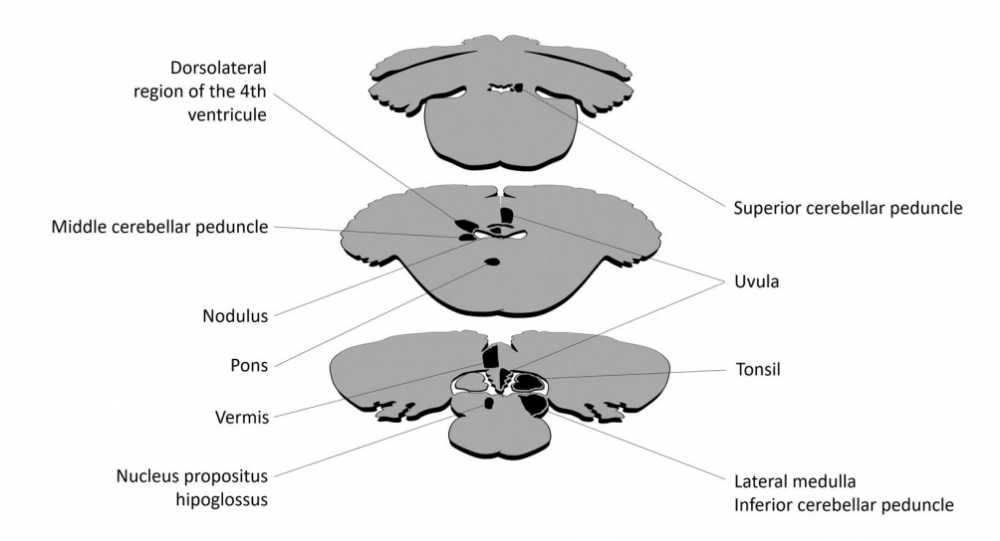
After: Lemos J, Strupp M. Central positional nystagmus: an update. J Neurol. 2022 Apr;269(4):1851-1860
(vv)CentralPV.mp4(tt)
(vv)NODULUSDBN.mp4(tt)
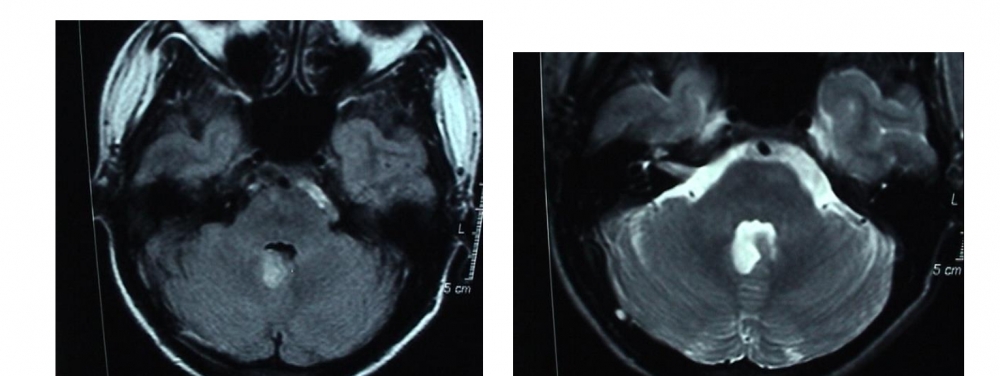
From: Zee DS. The cerebellum for the neuro-ophthalmologist: A video tutorial of some signs and syndromes to recognize NANOS 42nd Annual Meeting 2016. Retrieved from: https://collections.lib.utah.edu/ark:/87278/s6nw2r5g
A patient with vestibular migraine exhibits spontaneous left-beating direction-fixed horizontal central vestibular nystagmus in the upright position and then develops direction-changing horizontal geotropic positional nystagmus with either ear down.
(vv)BaranyCentralpositionalnystagmusa.mp4(tt)
From: Committee for the International Classification of Vestibular Disorders of the Barany Society.2.3.1.3.-Central-positional-nystagmus. Retrieved from http://www.jvr-web.org/images/2.3.1.3.-Central-positional-nystagmus-A.m4v
A patient with a superior cerebellar arteriovenous malformation exhibits persistent downbeat nystagmus in either Dix-Hallpike position.
(vv)2313Centralpositionalnystagmusb-11.mp4(tt)
From: Committee for the International Classification of Vestibular Disorders of the Barany Society.2.3.1.3.-Central-positional-nystagmus. Retrieved from http://www.jvr-web.org/images/2.3.1.3.-Central-positional-nystagmus-B.m4v